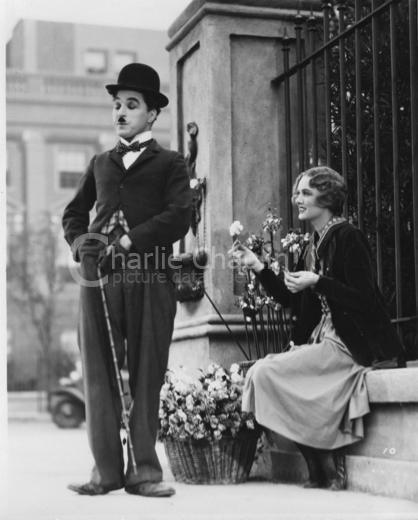
Before last night, I have only heard of "City Lights" and "The Holy Mountain;" I have never seen these films. So you can imagine how amazing it was for me to see these for the very first time on the big screen. The ending to "City Lights" has been noted by one critic as the best example of fine acting and directing, and as I sat there, watching the flower girl see for the first time the man who had helped lead her to a better life, a man who she believed was wealthy but now sees as a wandering vagabond, a man who she fell in love with but now sees for what he really is, was one of the most emotionally intense moments I ever had when watching a film. Indeed one of the best endings I have seen so far since Federico Fellini's "8 1/2" and "La Dolce Vita."
Reflecting back on the reviews I read for "The Holy Mountain," the film was everything I expected and more...a whole lot more...maybe "too-much-more". The images and sounds here are bound to unnerve anyone, from the crucified skinned dogs to the droning chants and noise that envelops the theatre upon the first scene, from the painful shrieks of the Christ-like protoganist waking up next to numerous wax models made in his image to the elderly fellow removing his false eye and placing it in the hand of a preteen female prostitute. For me, however, they were more spellbinding than they were unnerving; for my eyes to leave the screen would have been a sin. Symbolically, the film was rich, irreverent and smart. In particular, I enjoyed the jab taken at American tourists and their complacent obliviousness, where, in a Fellini-esque apocalyptic Mexico, white vacationers crowd around a heap of murdered Mexican children, snapping away with their cameras, gesturing and uttering feverishly in a fit of blind excitement. A fine-figured blond woman, tall and with a pet dog in her arms, is taken but a few distance away from the action by a Mexican patrolman, who then pins her to a wall, searches her, and rapes her; she is all the while smiling and demanding her husband that he take pictures of the raping, which he does, and with a smile of his own, too, a smile that acknowledges, of life in a different world, the novelty but not the ghastly, however real the ghastly is and however imaginary is the novelty.

Well, I've said enough about these movies, and surely a whole lot more can be said about them.
As I said before, NYC never fails the film lover, and the following are showing in the city each of which I hope I get to see before I go back to school in New Orleans:
--"There Will Be Blood" directed by Paul Thomas Anderson (one of my personally favorite directors)
--"Youth Without Youth" directed by Francis Ford Coppola
--"Smiley Face" directed by Gregg Araki ("Mysterious Skin," "The Doom Generation")
--"No Country For Old Men" directed by Joel and Ethan Coen
--"The Diving Bell and the Butterfly" directed by Julian Schnabel ("Before Night Falls")
--"Persepolis", an animated film based on a graphic novel by Marjane Satrapi
--"Margot at the Wedding" written and directed by Noah Baumbach ("Kicking and Screaming," "The Squid and the Whale")
--and of course, "Juno" and "Walk Hard" (a lot I have to see before I'm marooned once more on Tulane's uptown campus)
Happy Reading,
N. Antonio


No comments:
Post a Comment